False Positive in Acoustic Leak Detection of a Flooded Heating Pipeline: A Case Study in Hybrid AI Diagnostics
Aleksandr Ivanaiskii, PhD
Industrial AI Founder & Systems Architect
Evgeny Ivanaiskii, PhD
Domain Expert
Sergei Shipilov
AI Architecture Lead, Rivixi LLC
Abstract
This paper presents a field case study of a false positive leak verdict issued by conventional acoustic inspection equipment during the examination of a flooded district heating pipeline. Independently, both the third-party analog defectoscope and all primary AI modules of the RIVIXI Diagnose platform — cloud spectrogram classifier, edge AI classifier, and the classical correlation channel — classified intense hydrodynamic background noise as an active pipe leak. The system's final correct verdict — no excavation required — was produced exclusively by its hybrid physical layer: peak-to-noise ratio (PNR = 8.64) and phase coherence (0.4%). The case demonstrates the fundamental limitation of classifiers trained solely on acoustic patterns and provides empirical justification for hybrid DSP + AI architectures in pipeline diagnostics.
Keywords: pipeline leak detection, false positive, cross-correlation, PNR, phase coherence, hybrid AI diagnostics, non-destructive testing
Field date: 23 January 2026 · Site: Yuzhnoye Butovo District, Moscow, Russia
1. Site Description and Field Conditions
Pipeline Parameters:
Steel district heating pipeline; section length ; nominal pipe specification ; operating pressure ; supply/return temperatures . Location: Yuzhnoye Butovo, Varshavskoe Highway, Moscow.
Site Condition:
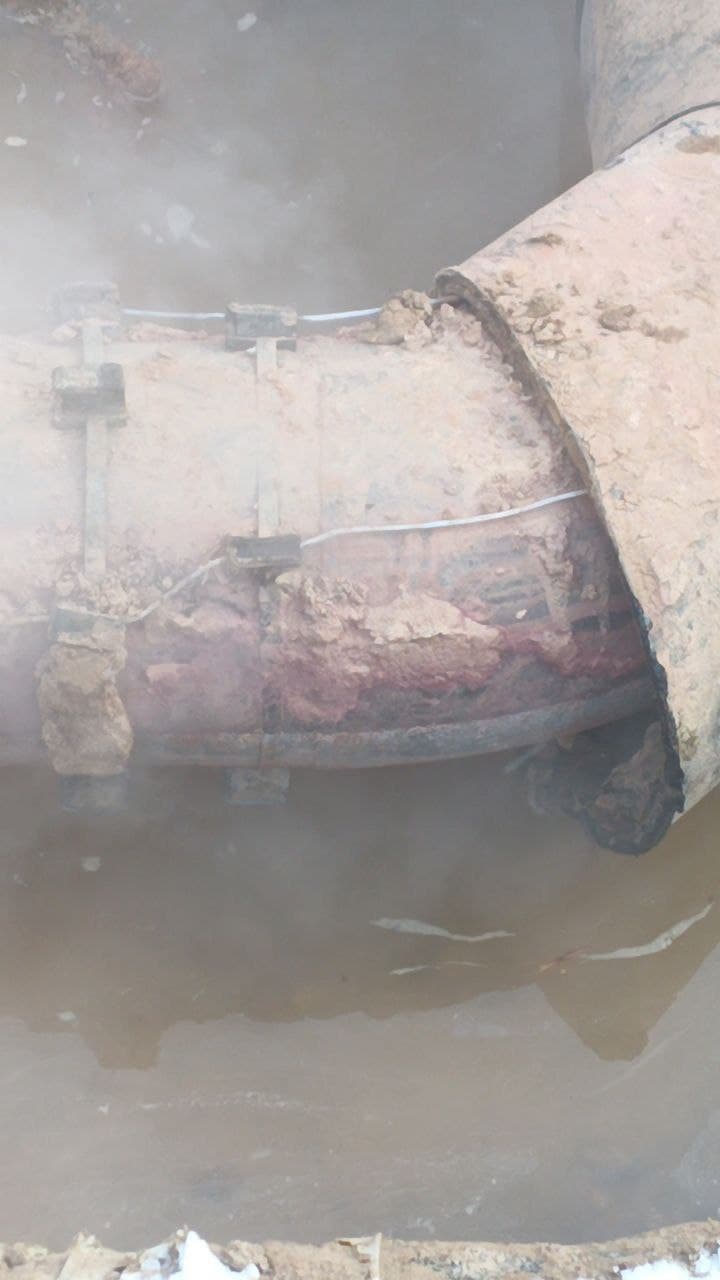
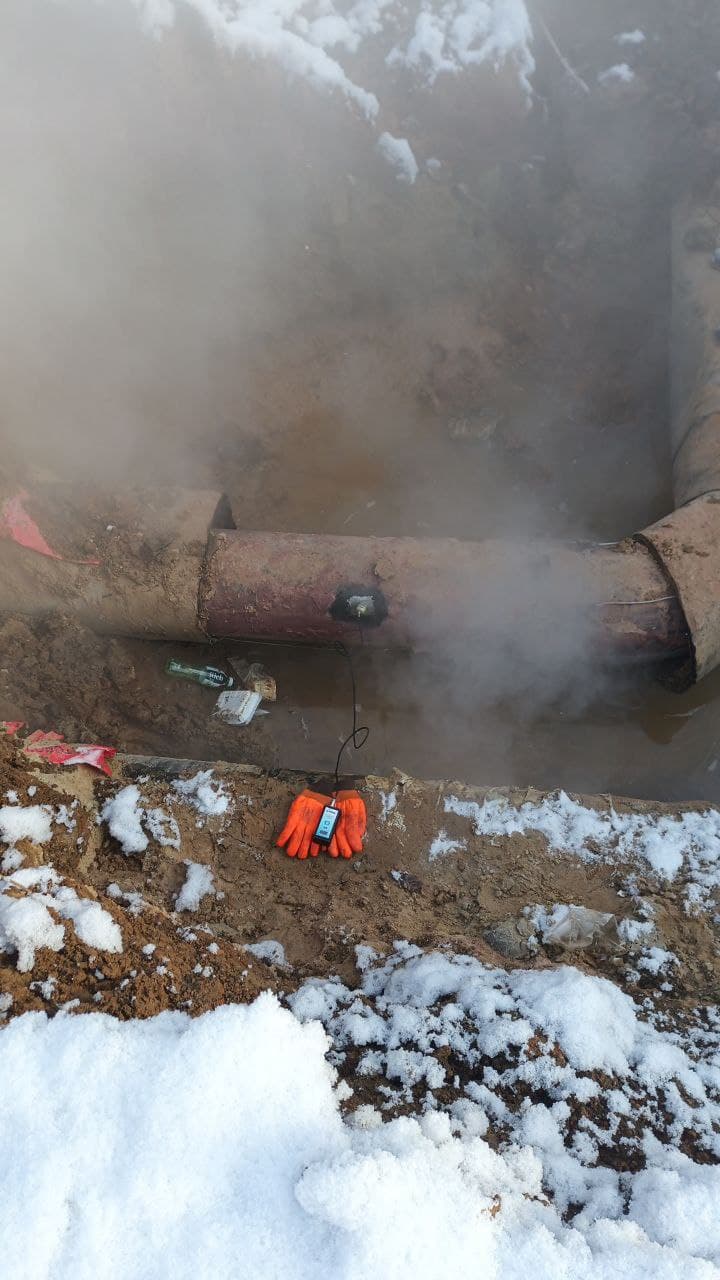
The pipeline runs through a concrete utility duct that was found completely flooded with groundwater and snowmelt. The factory-applied polyurethane foam (PUF) insulation had degraded and the outer polyethylene (PE) jacket was cracked throughout. The pipeline's remote leak monitoring system (SODKE) had been rendered inoperative by corrosion and provided no telemetry.
The photographs below document the excavation site, pipe surface condition, and sensor installation:
2. False Verdict of the Third-Party Diagnostic Equipment
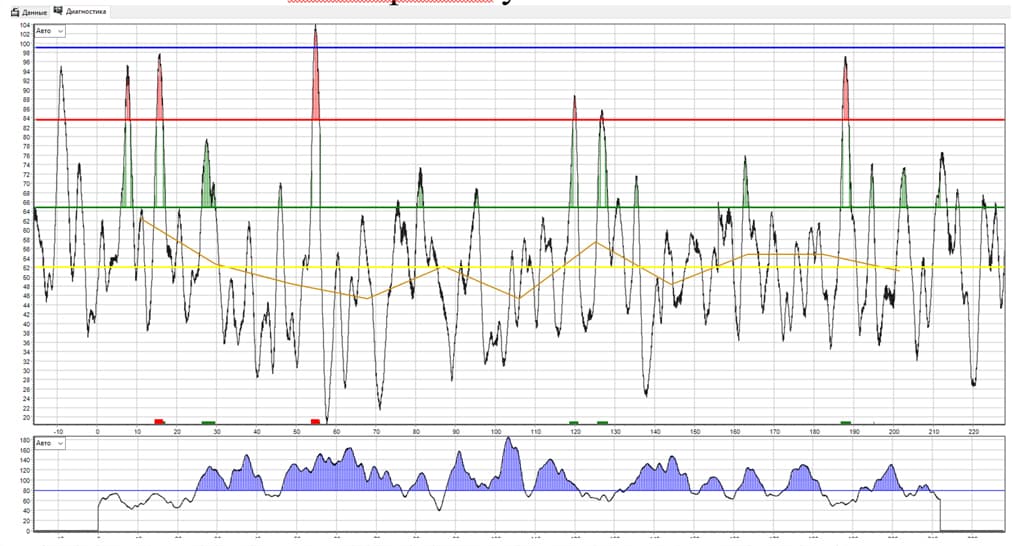
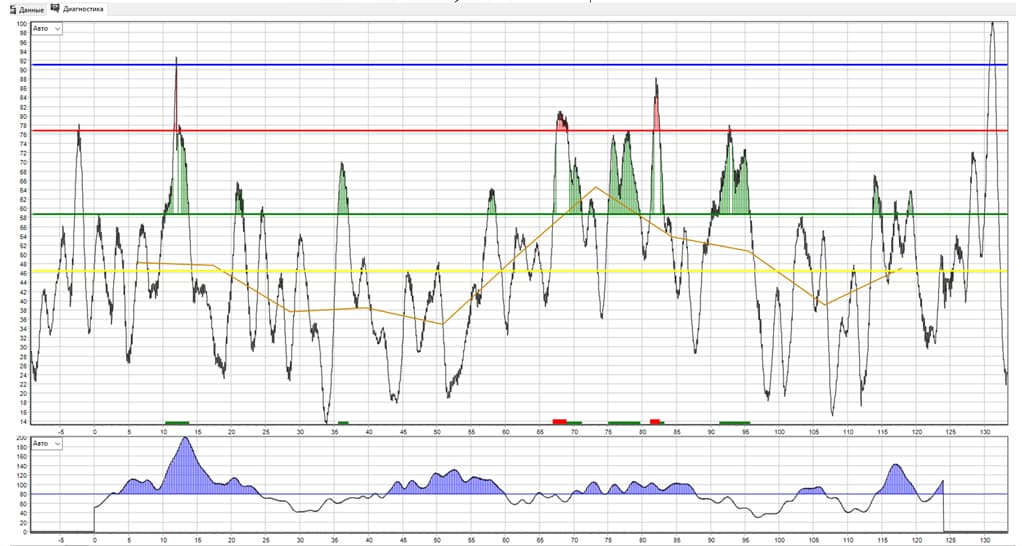
The absence of thermal insulation and the continuous contact between the pipe surface and the surrounding water column produced intense hydroacoustic noise throughout the section. A third-party NDT crew conducting a scheduled inspection with a standard acoustic correlator recorded a high-amplitude acoustic signal. With no visual access to the pipe and relying solely on signal amplitude and shape, they classified the anomaly as an active pinhole leak and issued a formal emergency excavation order.
The tomograms from their diagnostic system are shown below:
3. Parallel Inspection by RIVIXI Diagnose
A parallel diagnostic session was conducted by RIVIXI Diagnose specialists to verify the anomaly. The results of the initial analysis across all three primary detection modules are summarised below:
| Module | Verdict | Probability / Score |
|---|---|---|
| Cloud spectrogram classifier | Leak detected | 100.0% |
| Edge AI classifier | Leak detected | 98.3% |
| Analog correlation channel | Leak suspected (Z-Score 6.95) | 69.5% |
All three modules independently flagged the signal as a leak — creating a high risk of a false excavation order identical to the one issued by the third-party crew.
Why Both Neural Networks Fail on This Signal
Intense hydrodynamic noise in a flooded duct produces a continuous, broadband acoustic signal that is acoustically indistinguishable from an active pinhole leak for any classifier trained exclusively on acoustic waveform patterns:
- Cloud spectrogram classifier processes a mel-spectrogram and observes a uniformly high-energy band across the entire analysis window — consistent with its training examples of leak signals.
- Edge AI classifier processes the raw time-domain waveform and observes sustained high-frequency energy with impulsive bursts — again consistent with a leak signature.
In both cases, the classifier produces a confident "leak" output.
Note on Figure 4 axes: The X-axis represents time bins (not absolute seconds); the Y-axis represents mel-frequency bins (0–128, not Hz); colour encodes normalised energy amplitude. Mel bins 0–105 correspond to the high-frequency region of the spectrum and appear saturated throughout the entire recording duration — the diagnostic signature of a distributed ambient noise source.
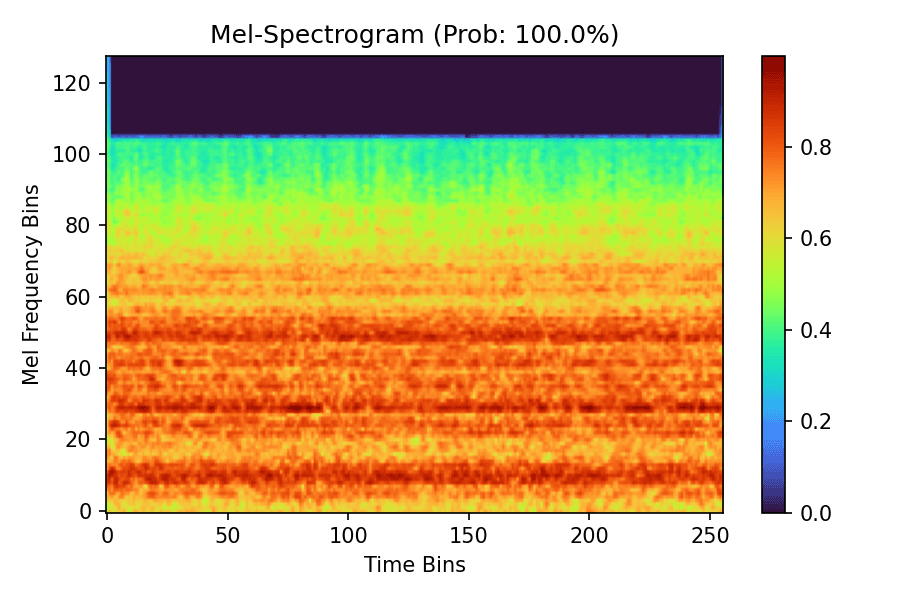
This case demonstrates the fundamental limitation of acoustic pattern classifiers: neither edge AI classifier nor cloud spectrogram classifier, operating in isolation, can distinguish distributed hydrodynamic noise from a genuine point-source pipe leak.
4. Defectoscope Module: 2D Cross-Correlation Map
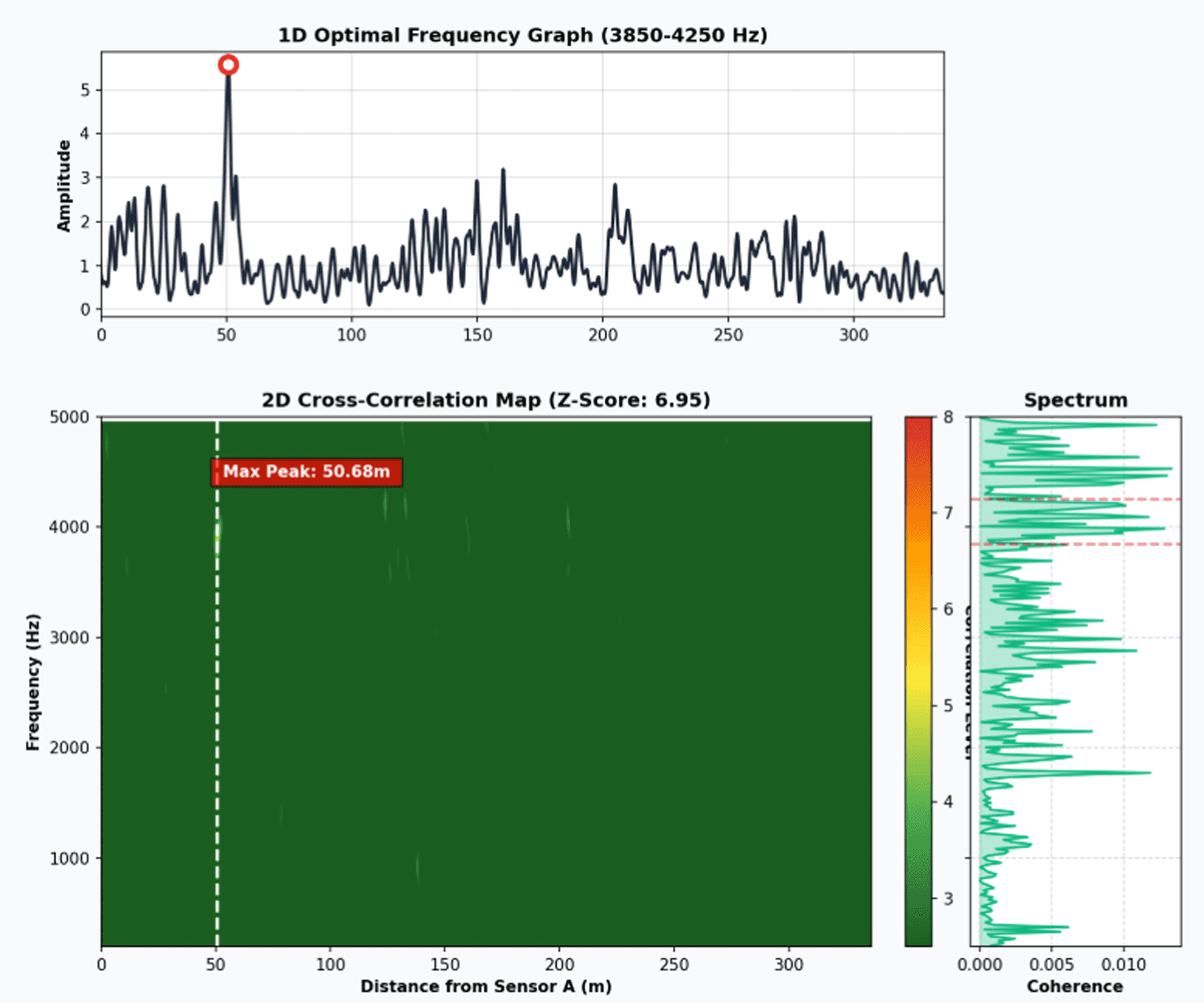
In addition to the AI model classifiers, the RIVIXI defectoscope module produces a 2D narrowband cross-correlation map. The results for this site are as follows:
| Parameter | Value |
|---|---|
| Detected distance to false peak | 50.68 m from Sensor A |
| Z-Score | 6.95 (calibrated suspicion zone; confirmation threshold not exceeded) |
| Leak probability (defectoscope channel) | 69.5% |
| Third-party peak position | ~55 m from sensor |
The two systems, operating independently with different hardware and algorithms, localised the anomaly to the same zone — approximately 50–55 m from Sensor A. This spatial reproducibility confirms that the acoustic anomaly is physically real. The signal is not a measurement artefact; however, as shown in Section 5, it does not originate from a point-source defect in the pipe wall.
5. Hybrid Physical Layer: PNR and Phase Coherence
The RIVIXI Diagnose platform implements a three-tier hybrid verification architecture to prevent costly false excavations triggered by pattern-based classifiers.
Tier 1 — Physical Filtering (PNR and Coherence)
| Physical Metric | Measured Value | Leak Threshold | Decision |
|---|---|---|---|
| Peak-to-Noise Ratio (PNR) | 8.64 | ≥ [specified threshold] | ✗ Below threshold |
| Mean Phase Coherence (2–10 kHz) | 0.4% | ≥ [required threshold] | ✗ Below threshold |
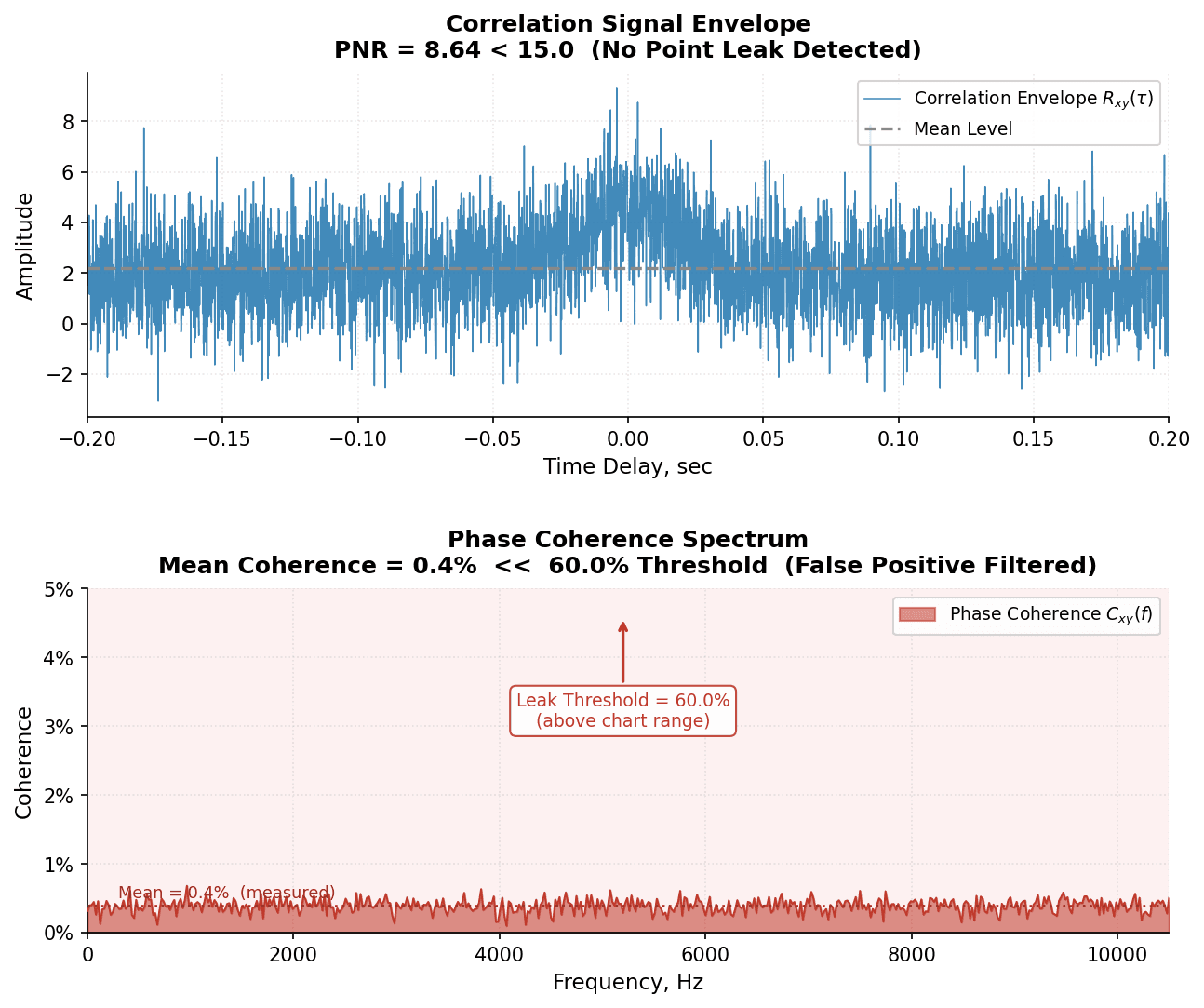
PNR = 8.64: The correlation envelope shows no discernible peak above the noise floor. For a genuine point-source leak, the peak of the cross-correlation function stands sharply above background, yielding PNR > [specified threshold]. A PNR of 8.64 indicates a spatially distributed source with no preferred time delay — the hallmark of ambient noise rather than a leak.
Phase Coherence = 0.4%: For a genuine leak, the acoustic wave propagates as a coherent travelling wave between the two sensors, producing consistent phase relationships across the frequency spectrum. A coherence of 0.4% against a [required threshold] indicates that the phase of the signal is effectively random — characteristic of a diffuse, incoherent noise field generated by turbulent water movement around the sensors, not by a pipe wall perforation.
Tier 2 — Long-Section Analog Bypass
For pipelines longer than 60 m, high-frequency signal components undergo strong attenuation in soil and pipe metal, making the analog amplitude channel highly susceptible to false triggering from ambient noise. The bypass rule is: on sections where , the platform programmatically overrides any analog alarm (analogScore >= [specified threshold]) if and only if neither neural network independently confirms a leak (both classifiers below [threshold value]), automatically classifying the anomaly as spatially distributed ambient noise. The analog channel retains decision authority only on short sections () and only when at least one AI model corroborates its output.
Note on this case: Both AI models exceeded the decision threshold (100.0% and 98.3%), so Tier 2 did not activate here. The excavation recommendation was suppressed by Tier 1 (PNR and coherence below physical thresholds) and Tier 3 (long-section logic), not by the analog bypass.
Tier 3 — Long-Section Logic ()
With PNR = 8.64 below [specified threshold] and coherence = 0.4% below [required threshold], and the section length of 336 m placing this firmly in the long-section regime, the meta-classifier assigns the signal to the boiling_water class (distributed hydrodynamic noise) and suppresses the excavation recommendation.
6. System Final Verdict and Field Confirmation
The RIVIXI Diagnose hybrid architecture produced the following final output:
FINAL VERDICT:  FALSE POSITIVE — DISTRIBUTED AREA SIGNAL
Meta-classifier (Random Forest): 100.0% false-positive probability
Trigger:  PNR = 8.64 below [specified threshold]  |  Coherence = 0.4% below [required threshold]
Signal class:  boiling_water  (distributed hydrodynamic noise)
Excavation recommendation:  NOT ISSUED
The third-party NDT crew nonetheless proceeded with excavation under their own emergency order. Upon opening the trench, no active leak was found (Third-Party Report No. 1, dated 23.01.2026). The RIVIXI verdict was confirmed correct.
7. Discussion
The case raises an important question for the field of acoustic pipeline diagnostics: if both state-of-the-art neural networks and professional human-operated equipment converged on the same wrong answer, what separates a reliable diagnostic system from an unreliable one?
The answer demonstrated here is physical grounding. Neural networks learn statistical associations between acoustic patterns and labels. They cannot reason about the physics of wave propagation. A continuous broadband noise source generates a waveform that is statistically similar to a leak — both produce energy in the 2–8 kHz band, both produce high-amplitude time series. The classifier has no way to distinguish them from the waveform alone.
PNR and phase coherence are not pattern-matching metrics. They measure properties of the acoustic field that have direct physical interpretations: the spatial concentration of the source (PNR) and the stationarity of the wave front (coherence). A distributed noise source will always produce low PNR and low coherence, regardless of its amplitude. These metrics are therefore structurally immune to the class of false positives demonstrated in this case.
The spatial agreement between the two independent systems (~50 m vs. ~55 m, an 8% difference attributable to different propagation speed assumptions) is itself a finding: it confirms that the anomaly is physically reproducible. This rules out sensor malfunction or measurement error as explanations, and strengthens the interpretation that the signal is a genuine physical phenomenon — but one originating from the water column, not from the pipe wall.
8. Conclusions
-
Both edge AI classifier and cloud spectrogram classifier independently produced false positive verdicts (98.3% and 100.0% respectively) in the presence of intense hydrodynamic background noise. The two classifiers fail for structurally identical reasons: neither can distinguish acoustic pattern signatures of distributed noise from those of a point-source leak.
-
Physical metrics (PNR = 8.64 and coherence = 0.4%) produced the correct verdict — one that no waveform-pattern classifier can independently arrive at, because it requires reasoning about the spatial and phase structure of the acoustic field.
-
A hybrid architecture combining physical signal processing with neural network classification is necessary and sufficient to prevent the class of false positive excavations demonstrated here. Neither component alone provides the required specificity.
-
The spatial reproducibility of the anomaly across two independent systems (third-party equipment and RIVIXI) confirms that the signal is a real physical phenomenon. Transparency about this finding — including the fact that both systems initially flagged a leak — is essential for honest reporting and enables other practitioners to calibrate their own diagnostic thresholds.
-
The audio recordings are made available (see Section 9) so that the analysis can be independently reproduced, verified, or used for training and benchmarking of other diagnostic systems.
9. Open Data
The audio recordings used in this analysis are available for independent verification:
| File | Description |
|---|---|
| audio_case1_section2_recording1.wav | Site 2, Recording 1. Sensors in A→B orientation |
| audio_case1_section2_recording2.wav | Site 2, Recording 2. Sensors in B→A orientation (inverted) |
Recording parameters: ; pipe steel; medium: water; sample rate ; dual-channel stereo WAV.
The two recordings were made consecutively on the same section with sensor positions swapped. Cross-referencing the two recordings confirms the spatial stability of the anomaly and rules out single-sensor artefacts.
Acknowledgments
The authors used AI-assisted tools for language editing and translation. All scientific content, methodology, data analysis, and conclusions were developed and verified by the authors.
References
- Ivanaiskii, A., Ivanaiskii, E., & Shipilov, S. (2026). Topological AI-analysis vs. classical cross-correlation: Overcoming legacy defectoscope vulnerabilities [Preprint]. Zenodo. https://doi.org/10.5281/zenodo.20673744
- Ivanaiskii, A., Ivanaiskii, E., & Shipilov, S. (2026). Seeing sound: A computer vision approach to ultrasonic leak detection in industrial pipelines [Preprint]. Zenodo. https://doi.org/10.5281/zenodo.20675041
- Ivanaiskii, A., Ivanaiskii, E., & Shipilov, S. (2026). Utilizing zero-crossing rate (ZCR) for acoustic leak detection in pipelines: From empirical models to a physically grounded DSP pipeline [Preprint]. Zenodo. https://doi.org/10.5281/zenodo.20740891
Citation
This research paper is permanently archived as a preprint on Zenodo:
Ivanaiskii, A., Ivanaiskii, E., & Shipilov, S. (2026). False Positive in Acoustic Leak Detection of a Flooded Heating Pipeline: A Case Study in Hybrid AI Diagnostics [Preprint]. Zenodo. https://doi.org/10.5281/zenodo.20822861