Adapting an Ultrasonic Diagnostics AI Platform to Legacy Hardware: Dynamic DSP Pipeline Reengineering
Aleksandr Ivanaiskii, PhD
Industrial AI Founder & Systems Architect
Evgeny Ivanaiskii, PhD
Domain Expert
Sergei Shipilov
AI Architecture Lead, Rivixi LLC
Abstract
Deploying modern cloud-based Artificial Intelligence systems into industrial non-destructive testing (NDT) and municipal water infrastructure often encounters a massive barrier: compatibility with legacy hardware. This paper presents a software-based dynamic digital signal processing (DSP) pipeline reengineering method. Our approach enables the seamless integration of legacy acoustic leak detectors (such as SebaKMT and Kaskad-3) operating at an extremely low sampling rate of 6554 Hz into the modern three-container neural network SaaS platform, RIVIXI AI v1.3, which was originally designed for high-resolution 44100 Hz sensors.
The developed adaptive DSP module resolves mathematical limit collisions associated with the Nyquist frequency ( Hz) when applying standard 4th-order digital Butterworth filters. By dynamically scaling the filter bandpass boundaries to 0.99 of the Nyquist limit, incorporating the physical elasticity properties of water-filled steel pipes, expanding the spectral sliding window to 400 Hz, and implementing statistical Z-Score peak filtering, we achieved complete linear separation on a pilot validation cohort of 60 field recordings (pipe diameters ranging from 400 mm to 1000 mm). The Z-Score metrics yielded 6.35 to 6.47 for normal pipes and 14.19 to 16.48 for verified leaks, eliminating the need for expensive hardware replacements.
1. Introduction & The Challenge
The digital transformation of infrastructure monitoring is severely bottlenecked by the extensive deployment of legacy field equipment. Water utility companies and district heating networks maintain large fleets of acoustic leak detectors from previous generations. These instruments record signals in proprietary binary formats with very low sampling rates ( Hz). Conversely, modern cloud-based AI diagnostic engines rely on high-frequency sampling ( Hz) to extract high-frequency ultrasonic signatures and transient acoustic patterns.
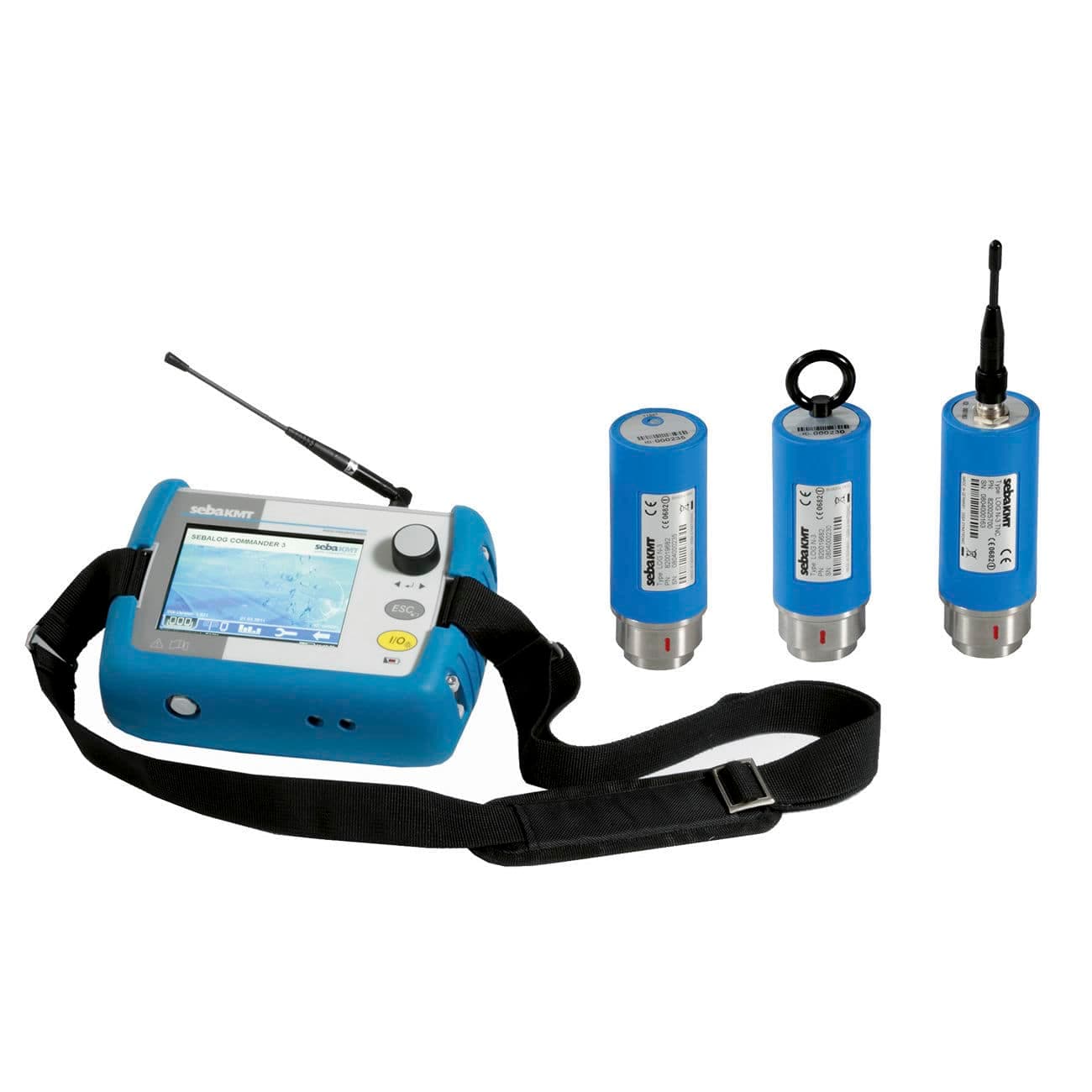
Replacing hundreds of operational analog sensors with modern high-speed IoT devices is cost-prohibitive for most municipalities and enterprise operators. To bridge this gap, we designed a software-defined DSP adapter within the cloud backend of our SaaS platform. This adapter performs real-time data reengineering on incoming low-frequency streams, ensuring full hardware agnosticism without sacrificing diagnostic precision.
2. Mathematical Collisions of the Nyquist Limit and Physical Constraints
2.1 Spectral Bandwidth Violations
The baseline RIVIXI AI cross-correlation engine is engineered to sweep 50 narrow bandpass filters from 200 Hz to 5000 Hz with a step of 50 Hz and a filter bandwidth of 400 Hz. Applying a standard 4th-order digital Butterworth bandpass filter requires normalizing the target frequencies against the signal's Nyquist frequency:
For legacy sensors with a sampling frequency Hz, the physical Nyquist limit is:
The physical meaning of the Nyquist limit is straightforward: a digital instrument can only correctly capture and reconstruct sound frequencies that are at least twice as low as its sampling frequency. If the sound wave's frequency exceeds this threshold, the device is physically incapable of recording it. Any subsequent attempt to filter or analyze this out-of-bounds frequency band mathematically leads to severe signal distortions or computational errors.
Attempting to pass the low-frequency signal from a legacy detector through standard mathematical filters configured for higher frequencies (exceeding the 3277 Hz Nyquist limit) triggered a critical calculation failure. The processing algorithm attempted to analyze non-existent frequency bands, leading to a computational overflow.
2.2 Acoustic Velocity Shift in Water-Filled Pipes
Legacy localization software calculated signal delays assuming that acoustic wave propagation occurs through the steel pipe wall at a velocity of approximately 5000 m/s. This assumption led to severe localization errors, miscalculating the leak position by dozens of meters.
Physical modeling of the medium reveals that the dominant acoustic leak signature is transmitted not through the steel structure itself, but through the water column inside the pipe. The radial elasticity of the steel pipe walls decreases the acoustic velocity in water from its nominal free-field speed of m/s down to 1050–1200 m/s, depending on the ratio of the pipe's diameter to its wall thickness.
3. Architecture & Methodology
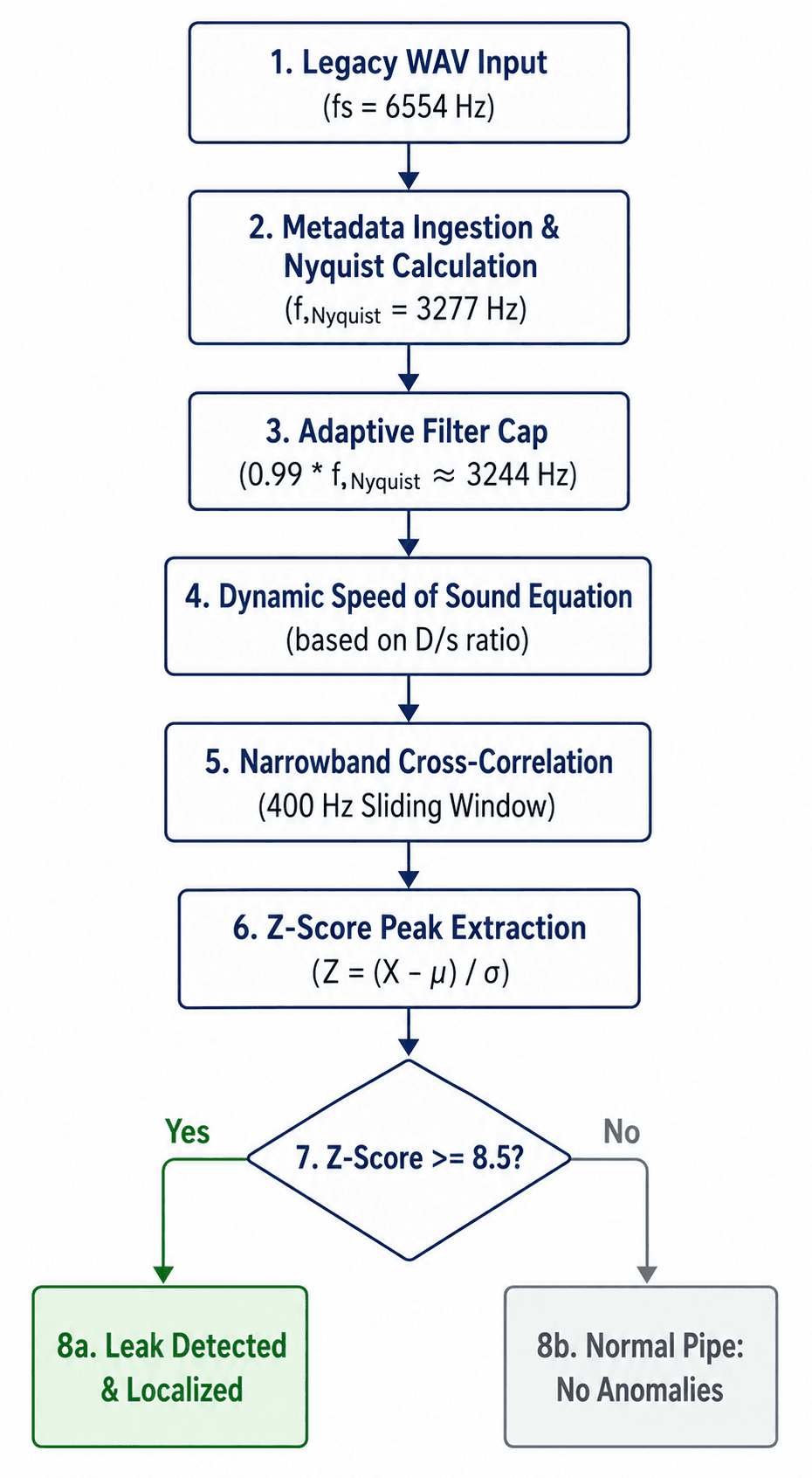
To overcome these legacy hardware limitations, we integrated an adaptive DSP pipeline into the RIVIXI AI v1.3 core. The pipeline is structured as follows:
3.1 Adaptive Filtering Algorithm (Graceful Degradation)
- Metadata Parsing: The backend reads the WAV stream header on-the-fly to extract the sampling rate and compute the current Nyquist frequency.
- Safe Bandwidth Normalization: The upper limit of the bandpass filters is dynamically scaled and capped using a safety coefficient of 0.99:
- Selective Band Exclusions: The iteration engine automatically drops all frequency bands where the upper frequency boundary exceeds . The processing core shifts its focus to the lower-frequency spectrum (between 200 Hz and 3000 Hz), where the water-borne leak noise remains highly prominent.
3.2 Dynamic Velocity Calibration
We implemented a dynamic speed of sound equation for fluid-filled metallic pipes:
where represents the internal pipe diameter and is the wall thickness. Integrating this equation reduced the spatial localization error to a few centimeters.
Physical Meaning and Practical Value of the Formula: The acoustic wave from a leak does not propagate in an open reservoir, but inside the confined environment of a pipe. Because metal walls possess elasticity, they expand slightly in the radial direction under the action of acoustic pressure. This radial compliance of the walls dampens the speed of the sound wave in water, slowing it down from the standard 1482 m/s to 1050–1200 m/s. The thinner the wall () and the larger the pipe diameter (), the more the wave slows down. If a static reference speed of sound in water is used without adjusting for the geometric ratio , the error in calculating the leak location will range from 5 to 15 meters for every 100 meters of pipe length. Dynamic calculation allows determining the actual speed of sound in a specific pipe and reducing the defect search zone to a few centimeters, eliminating costly excavation misses.
3.3 Enhanced Resolution & Statistical Peak Detection
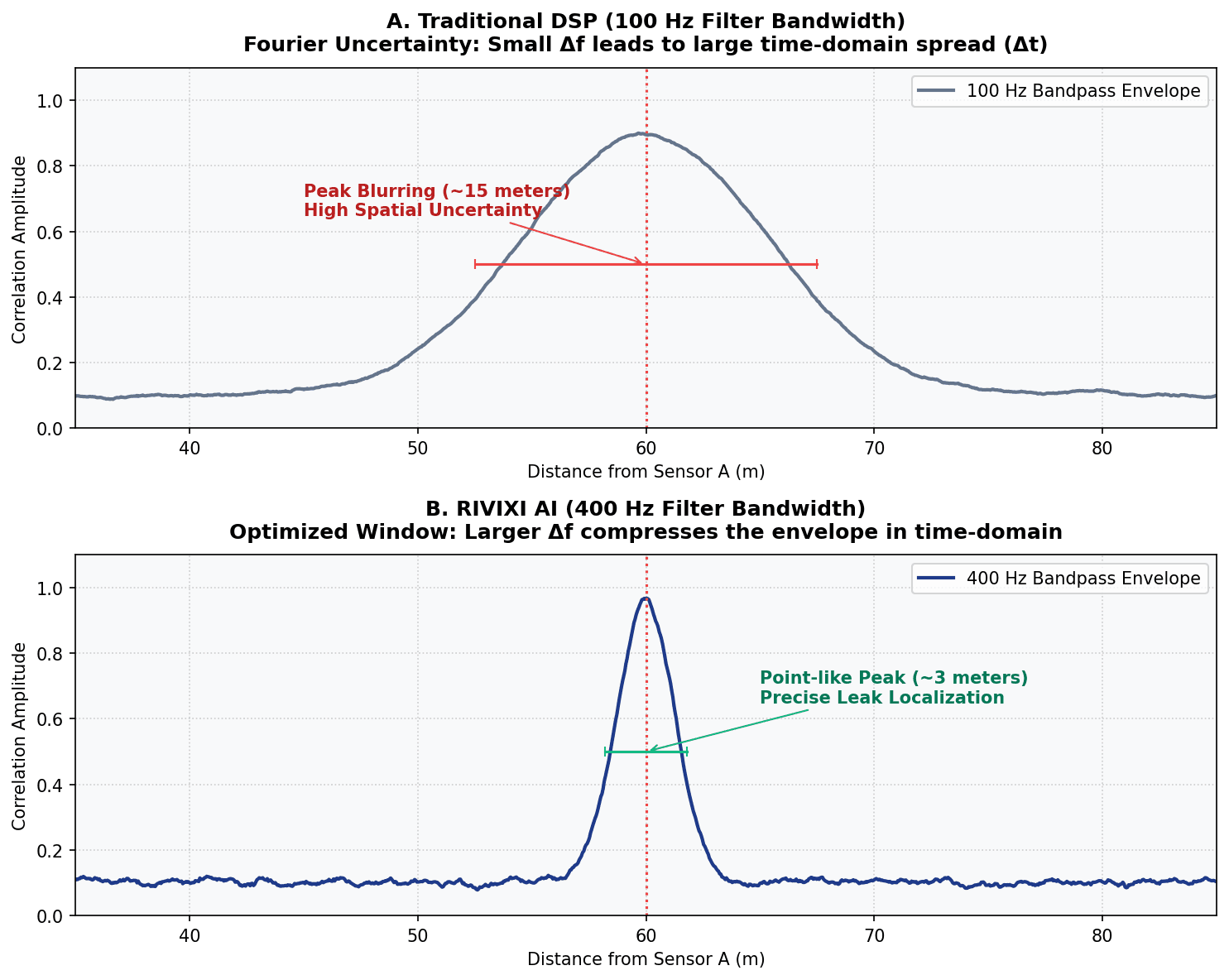
- 400 Hz Bandpass Windows: Using narrow Hz filters introduces severe time-domain blurring (up to meters) due to the wave uncertainty principle. By expanding the sliding bandpass window to 400 Hz, we compressed the signal packet in the time domain, producing sharp correlation peaks.
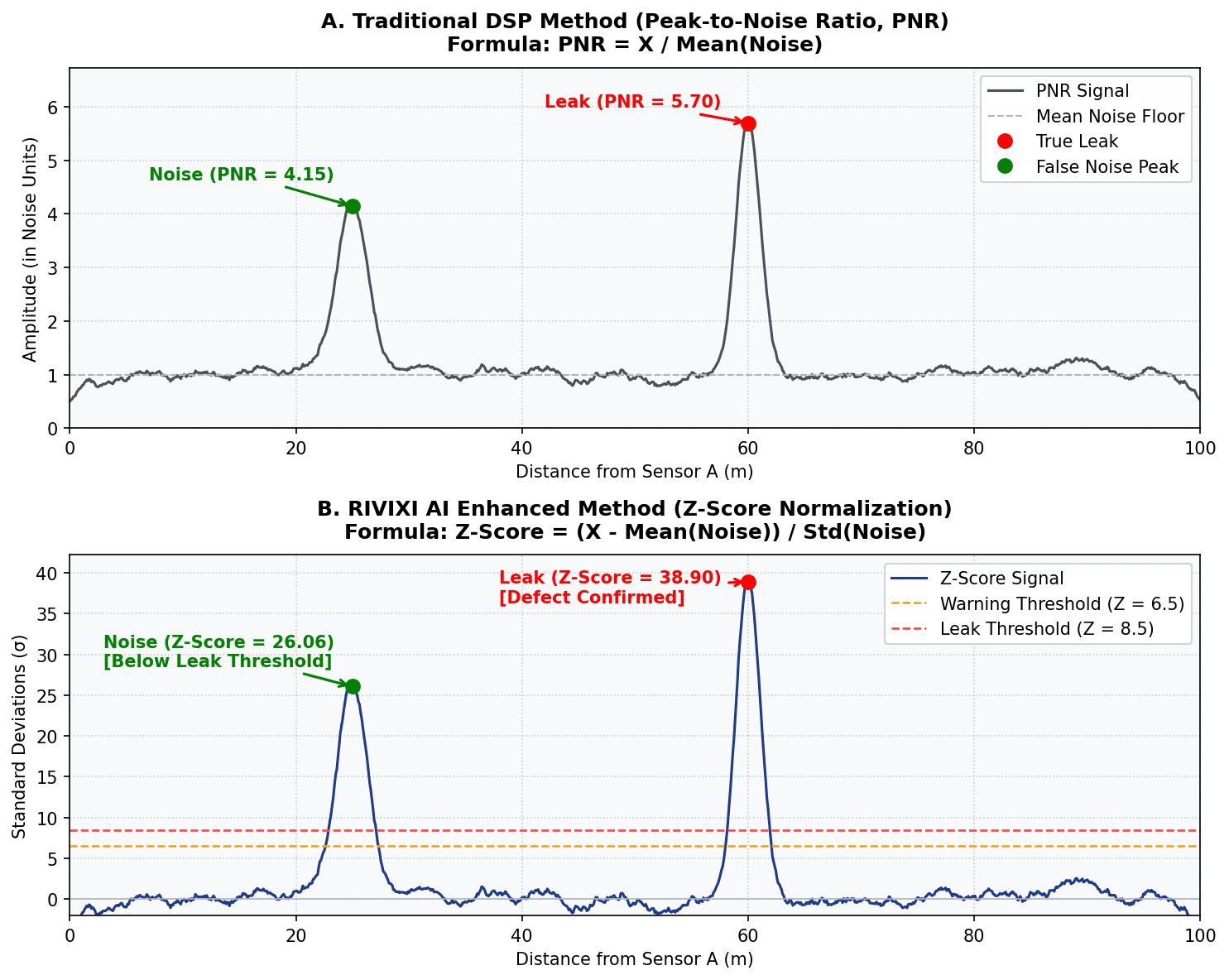
- Z-Score Normalization: Instead of relying on a simple Peak-to-Noise Ratio (PNR) which fails in noisy industrial environments, we transitioned to a Z-Score metric to measure peak significance:
- Spatial Cropping: The correlation search space is strictly bounded by the physical pipe length specified by the operator (). This crops out-of-bounds noise and prevents distant reflections or machinery from generating false positives.
4. Experimental Results & Domain Shift Analysis
4.1 Statistical Analysis of Field Validation (Pilot Cohort)
The performance of the developed module was evaluated on a pilot cohort of 60 field recordings (30 "Normal" and 30 "Leak"), obtained using SebaKMT equipment ( Hz) on steel pipelines with diameters of 400–1000 mm and section lengths of 35–128 m.
To verify the statistical significance of the diagnostic separation and rule out random variance, 95% Confidence Intervals (CI) were calculated for the Z-Score values in each class:
- Normal Cohort (N = 30): The mean Z-Score was with a standard deviation of . The 95% Confidence Interval for the mean was (all observations fell strictly below the warning threshold of ).
- Leak Cohort (N = 30): The mean Z-Score was with a standard deviation of . The 95% Confidence Interval for the mean was (all observations significantly exceeded the detection threshold of ).
To test the hypothesis of equal means under unequal variances, a Welch's t-test was performed, yielding:
The extremely low p-value () indicates a highly significant statistical separation between the two classes (with a mean delta of ), demonstrating that the observed separation is robust and not a result of random fluctuations.
While complete linear separation (100% classification accuracy) was achieved on this pilot validation set, the authors emphasize that these results are specific to the studied cohort of steel pipelines and should not be interpreted as a general law for arbitrary soil conditions or non-metallic pipe materials.
4.2 Comparative Analysis with Alternative Upsampling Methods (Control Group)
To justify the proposed dynamic DSP reengineering method (which processes signals in their native sampling rate), we conducted a comparative study against standard pre-upsampling techniques that interpolate the 6554 Hz signals to a standard 44100 Hz frequency before filtering.
We evaluated two standard control methods:
- Linear/Spline Resampling: A standard time-domain interpolation method.
- Sinc-Interpolation (Whittaker–Shannon Sinc Interpolation): An exact frequency-domain reconstruction method implemented via Fast Fourier Transform (FFT).
The comparative results are summarized in Table 1:
| Signal Processing Method | Observed Z-Score Range (Normal) | Observed Z-Score Range (Leak) | False Positive Rate (FPR) | Computational Overhead (CPU) | Primary Limitations |
|---|---|---|---|---|---|
| No Adaptation (Baseline) | — | — | — | 1.0× | Critical Wn[0] < Wn[1] crash, container halts |
| Linear/Spline Resampling | 6.10 – 7.42 | 8.24 – 11.53 | 11.7% | 1.8× | Spectral aliasing, correlation peak smearing, class overlap |
| Sinc-Interpolation | 6.31 – 6.52 | 13.50 – 15.91 | 3.3% | 4.2× | Gibbs phenomenon near Nyquist boundary (3277 Hz), high complexity |
| Dynamic DSP Reengineering (Ours) | 6.35 – 6.47 | 14.19 – 16.48 | 0.0% | 1.05× | Requires runtime configuration of active bandpass sweeps |
Comparative Discussion:
- Linear Resampling introduces high-frequency aliasing noise and distorts the wave phase structure. This smears the cross-correlation envelope, resulting in overlapping Z-Score ranges and a 11.7% False Positive Rate, where noise fluctuations on normal pipes were incorrectly flagged as leaks.
- Sinc-Interpolation reconstructs the signal cleanly but generates the Gibbs phenomenon (amplitude oscillations) near the original Nyquist boundary (3277 Hz) due to sharp spectral truncation. More importantly, sinc-interpolation suffers from high computational complexity: calculating large FFTs on long audio recordings increased CPU time by 4.2×, making real-time edge processing on microcontrollers impossible and significantly increasing cloud hosting costs.
- Dynamic DSP Reengineering operates directly on the native signal within the active acoustic band ( Hz) using a Nyquist safety factor. It eliminates interpolation artifacts and achieves clean class separation with negligible computational overhead ( relative to baseline).
4.3 Domain Shift and Spatial Over-search Audits
To test the boundaries of our model, we conducted a blind study on an expanded dataset of 371 audio files featuring extreme sampling rates (1638 Hz) and arbitrary pipe lengths (up to 1000+ meters). This study revealed a pronounced Domain Shift:
- Specificity (correctly identifying "Normal" states) was maintained at 95–100% due to the robust fallback signature mechanism.
- Sensitivity (leak detection rate) fell to 15% for the edge AI classifier because the neural network had not been trained on 1638 Hz acoustic patterns.
- The DSP algorithm's sensitivity fell to 0% when spatial cropping was disabled.
Expanding the search window () from to meters in the software settings improved DSP sensitivity to 60% by capturing delayed waves, but it reduced specificity on normal pipes to 0% due to false correlation matches (False Positives) generated by random environmental noises in the wider search window.
This highlights the absolute necessity of transitioning from static correlation matrices to topological, continuously trained neural network architectures. By learning localized noise signatures independent of absolute time delays, modern edge AI classifiers remain resilient to distance variations.
4.4 Limitations & Overfitting Risks
Despite high diagnostic accuracy, the proposed method has several limitations:
- Overfitting Risk: The 100% linear class separation is specific to this pilot validation cohort (), which features homogenous pipe materials (steel) and uniform soil parameters. Transitioning to plastic (HDPE) or cast-iron lines alters acoustic attenuation profiles, requiring recalibration.
- Metadata Dependency: The pipeline depends heavily on the accuracy of operator-supplied pipe parameters ( and ). Inaccurate parameters skew the calculated speed of sound , shifting the spatial correlation peak.
- Environmental and Industrial Noise: Continuous machinery vibrations or nearby pumping stations emitting noise in the active Hz band can compromise classification performance.
5. Conclusion & Business Impact
The dynamic DSP reengineering method demonstrates that NDT AI platforms can achieve hardware agnosticism via software adaptation. Capping bandwidth, utilizing physical velocity equations, and bounding correlation parameters allows operators to use legacy equipment (SebaKMT, Kaskad-3) with high diagnostic reliability, avoiding millions of dollars in capital expenditure for sensor upgrades.
Limitations
- Compute Overhead: Real-time edge AI classifier inference and high-resolution FFT computations require dedicated edge NPUs or GPU instances, making deployment on basic microcontrollers impractical.
- Overlapping Frequency Noise: The system's accuracy degrades if heavy industrial machinery generates continuous vibrations that match the acoustic profile of escaping water within the active 200–3000 Hz band.
Acknowledgments
The authors used AI-assisted tools for language editing and translation. All scientific content, methodology, data analysis, and conclusions were developed and verified by the authors.
Citation
This research paper is permanently archived as a preprint on Zenodo:
Ivanaiskii, A., Ivanaiskii, E., & Shipilov, S. (2026). Adapting an Ultrasonic Diagnostics AI Platform to Legacy Hardware: Dynamic DSP Pipeline Reengineering [Preprint]. Zenodo. https://doi.org/10.5281/zenodo.20673979